Workspace Science Test 112
← Back to Science
Science · Drill 112

Science practice 112

6 questions ~9 min recommended
00:00
Score

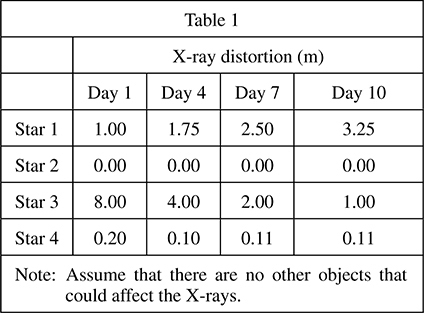
Table 1

X-ray distortion (m) Day 1 Day 4 Day 7 Day 10
Star 11 1.00 1.75 2.50 3.25
Star 2 0.00 0.00 0.00 0.00
Star 32 8.00 4.00 2.00 1.00
Star 4 0.20 0.10 0.11 0.11

Note: Assume that there are no other objects that could affect the X-rays.

Star 3 is likely orbited by at least one large planet.3

The change in X-ray distortion for Star 1 from Day 1 to Day 10 is 3.75 meters4.

This data suggests that X-rays are affected by certain physical forces.5

Based on the table, Stars 1, 3, and 4 only6 show measurable changes in X-ray distortion.
Scientists theorize that the release of X-rays by distant stars and the amount of distortion or "bending" the X-rays endure as they travel out of their solar system can help indicate the presence of planets orbiting these stars. The distortion of the X-rays would be caused by the gravitational pull exerted by the planets. Specifically, high "bending" in these rays would indicate the presence of large planets, while a low level of bending would most likely signify the presence of smaller planets.

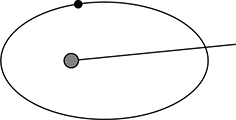
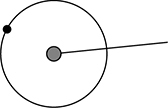
In addition to determining whether there are planets circling a distant star, the amount of X-ray distortion can determine the planets' orbital pattern. A circular orbit produces increasing or decreasing distortions of the same level. For instance, if a star's X-rays are bent 1 meter the first day, 2 meters the fourth day, 4 meters the seventh day, and so on, it indicates a circular orbit. See Figure 1. If, however, the pattern of bending is random, as in a bending of 5 meters the first day, 3 meters the second day, 0 meters the third day, and 7 meters the fourth day, then the planet's orbit is elliptical. See Figure 2. Further, if the paths of the X-rays are not bent in any way, it is assumed that the star lacks any planets.

Figure 1 Circular orbit

Figure 2 Elliptical orbit

Table 1 shows the amount of distortion of X-rays released by 4 different stars over a period of 10 days.

1. According to Table 1, which star most likely has no planets?

2. Based on the information in the passage, how many of the stars listed in Table 1 have at least one planet with a circular orbit?

3. Which of the following statements is best supported by information in the passage?

4. If X-ray distortion were observed for an additional three days, one could predict that the path of the X-rays produced by Star 1 on day 13 would be distorted by:

5. According to information in the passage, which of the following assumptions could be true?

6. Based on information in the passage, which of the following stars most likely has at least one planet with an elliptical orbit?