Workspace Science Test 109
← Back to Science
Science · Drill 109

Science practice 109

5 questions ~9 min recommended
00:00
Score
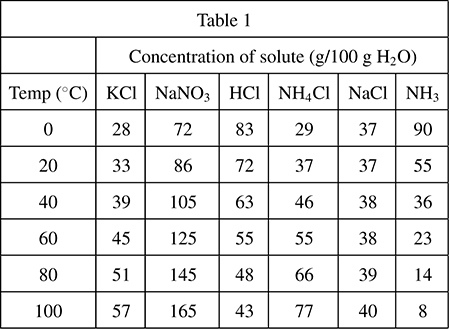
Table 1
Concentration of solute (g/100 g H2O)
Temp (°C) KCl1 NaNO32 HCl NH4Cl NaCl NH3
20 28 72 83 29 37 90
40 33 86 72 37 37 39
60 39 105 63 46 36 45
80 125 55 55 51
100 145 48 66 57
165 43 77 38

Based on the data presented in Table 1, answer the following questions:3

As temperature increases from 20°C to 100°C, the solubility of NH34 changes, while other substances show different patterns.5
A solute is any substance that is dissolved in another substance, which is called the solvent.

A student tested the solubility (a measure of how much solute will dissolve into the solvent) of six different substances. The solubility of a substance at a given temperature is defined as the concentration of the dissolved solute that is in equilibrium with the solvent.

Table 1 represents the concentration of dissolved substances in 100 grams of water at various temperatures. The concentrations are expressed in grams of solute per 100 grams of water.

1. According to Table 1, the concentrations of which of the following substances varies the least with temperature?

2. The graph below best represents the relationship between concentration and temperature for which of the following substances?

3. The data shown in Table 1 support the conclusion that, for a given substance, as the temperature of the water increases, the amount of solute that can be dissolved:

4. According to Table 1, HCl would most likely have which of the following concentrations at 70°C?

5. A scientist wants to dissolve at least 50 grams of NH4Cl in 100 g of water in order for the solution to be the proper concentration for use in an experiment. A reasonable minimum temperature for the solution would be: