Workspace Science Test 110
← Back to Science
Science · Drill 110

Science practice 110

5 questions ~9 min recommended
00:00
Score

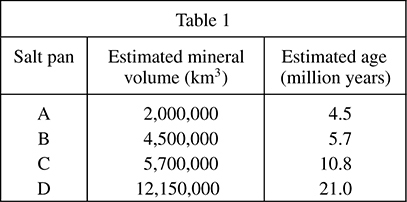
Salt pan A B D Table 1 Estimated mineral volume (km?) 2,000,000 4,500,000 5,700,000 12,150,000 Estimated age (million years) 4.5 5.7 10.8 21.0

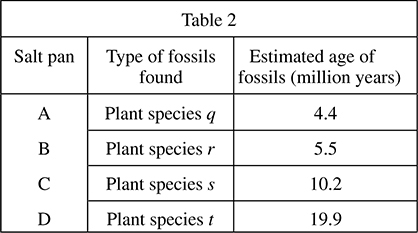
Salt pan D Table 2 Type of fossils found Plant species q Plant species r Plant species s Plant species t Estimated age of fossils (million years) 4.4 5.5 10.2 19.9

1 2 3 4 5
Salt pans are unusual geologic formations found in deserts. They are formed in endorheic basins, which are lowland areas where water collects but has no outflow. Any rain that falls or any water that is collected in an endorheic basin remains there permanently, except for what is lost through evaporation. This type of closed system often leads to a high concentration of salt and other minerals.

Study 1

Four different salt pans around the world were studied. The volumes of mineral deposits were estimated from the surface areas of the salt pans and the average thickness of the deposits. The ages of the salt pans were also estimated based on the mineral volume. The estimates are shown in Table 1.

Study 2

The same four salt pans were excavated for fossils. Fossil remnants of extinct plant species were found within each of the salt pans. The ages of the fossils found were similar to the ages of the salt pans (see Table 2). Scientists hypothesize that flooding of each salt pan may have led to the extinction of the plant species.

1. Which of the following statements is best supported by information in the passage?

2. Which one of the following graphs best represents the relationship between the mineral volume and the age of the salt pans, according to Study 1?

3. Is the conclusion that Salt pan A contains more extinct plant fossils than does Salt pan D supported by information in the passage?

4. From the results of Table 1, you could conclude that a salt pan formed more than 21 million years ago would have a mineral value:

5. A fossilized plant approximately 9.7 million years old was recently discovered in a salt pan in North America. It was most likely found in a salt pan similar to: