Workspace Science Test 114
← Back to Science
Science · Drill 114

Science practice 114

6 questions ~9 min recommended
00:00
Score

planted at:

planted at:

planted at:

S31

planted at:

planted at:

Site

S1

S3

S4

S5

2.1

3.9

0.4

5.2

1.8

Table 1

Pinecones produced per tree

A2

A3

A4

7.1

12.0

2.5

6.7

8.5

2.4

6.2

3.1

2.1

2.9

9.3

0.2

6.3

0.9

3.7

A5

3.1

6.4

7.2

4.5

8.5

Site

S1

S3

S4

S5

Table 2

Pinecones produced per Al2 tree when

planted with

A2

5.7

3.2

9.6

4.2

4.9

A3

A4

3.2

1.7

6.7

4.3

8.4

0.8

3.2

1.3

6.1

6.1

A5

3.5

5.2

7.0

0.2

3.9

3456
A researcher has conducted two experiments to test the rate of pinecone production in the Pinus palustris Miller (a type of pine tree).

Experiment 1

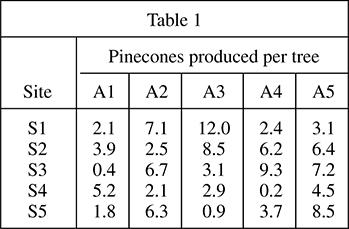
P. palustris Miller seeds were collected from 5 different populations (A1, A2, A3, A4, A5) each of which was from a different site (S1, S2, S3, S4, S5).

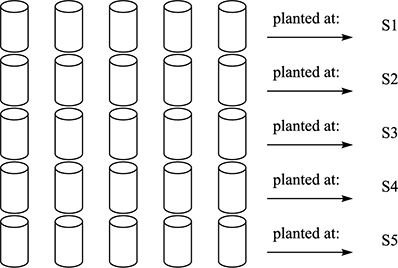
The seeds were grown under controlled conditions in a greenhouse. 300 of these seedlings from each population were chosen at random. Each set of seedlings was divided into 30 groups with 10 seedlings in each group. The seedlings were planted in marked cylindrical containers which were then placed at each of the 5 sites. Figure 1 shows the procedure for A1.

Figure 1 Twenty-five containers with a total of 250 A1 seedlings

Table 1 shows the number of pinecones that were produced on each tree.

The researchers also collected data on the root structure of the trees. From the information they collected they came up with the following formula relating the root structure in inches to the number of pinecones produced:

number of pinecones = 0.037 + 0.147 (root thickness)

Statistical analysis indicated that this equation was accurate.

Experiment 2

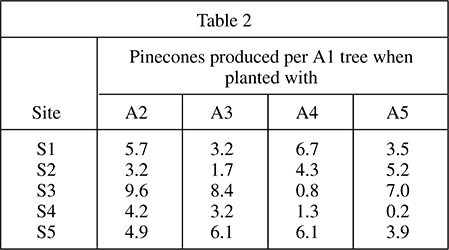
P. palustris Miller seeds were collected and grown in the same manner as in Experiment 1. When the seeds had grown into seedlings, 150 containers were prepared with 5 A1 seedlings and 5 seedlings from either A2, A3, A4, or A5. Seven containers for each of the 4 combinations were planted at each site.

Table 2 shows how many pinecones were produced on each A1 tree.

1. In Experiment 1, trees from A5 produced more pinecones than did trees from A4 at which of the following sites?

2. In Experiment 1, A1 trees produced the largest number of pinecones at which of the following sites?

3. The procedures utilized in Experiment 2 were repeated at a sixth site (S6). The results appear in Table 3.

Based on these data, one can conclude that A1 trees planted with A3 trees produced more pinecones at S6 than at any other site EXCEPT:

4. A student wanted to produce the greatest number of pinecones from 6 A1 trees, using the procedures from Experiment 2. Which plants and site should the A1 trees be combined with to achieve the desired results?

5. In which of the following ways was Experiment 2 different from Experiment 1?

6. In Experiment 2, how many seedlings were planted in each container?