Workspace Science Test 121
← Back to Science
Science · Drill 121

Science practice 121

6 questions ~9 min recommended
00:00
Score

Day

Day 1
Day 2
Day 3
Day 4
Day 1
Day 2
Day 3
Day 4

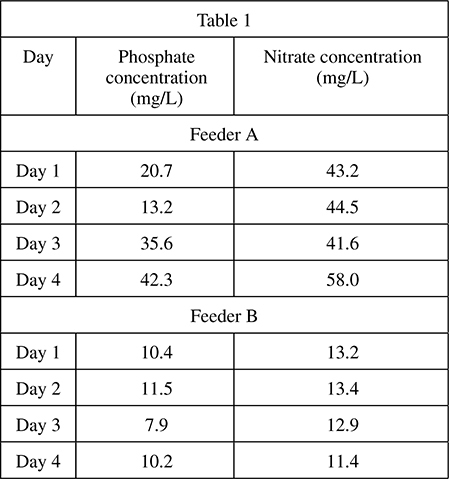
Table 1

Day Feeder A Feeder B
Phosphate concentration (mg/L) Nitrate concentration (mg/L) Phosphate concentration (mg/L) Nitrate concentration (mg/L)
Day 1 20.7 43.2 10.4 13.2
Day 2 13.2 44.5 11.5 13.4
Day 3 35.6 41.6 7.9 12.9
Day 4 42.3 58.0 10.2 11.4

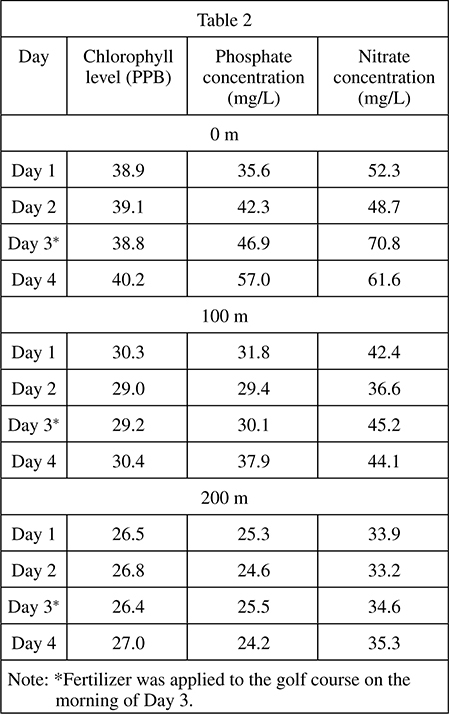
Table 2

Day Chlorophyll level (PPB) Phosphate concentration (mg/L) Nitrate concentration (mg/L)
0 m
Day 1 38.9 35.6 52.3
Day 2 39.1 42.3 48.7
Day 3* 38.8 46.9 70.8
Day 4 40.2 57.0 61.6
100 m
Day 1 30.3 31.8 42.4
Day 2 29.0 29.4 36.6
Day 3* 29.2 30.1 45.2
Day 4 30.4 37.9 44.1
200 m
Day 1 26.5 25.3 33.9
Day 2 26.8 24.6 33.2
Day 3* 26.4 25.5 34.6
Day 4 27.0 24.2 35.3

Note: *Fertilizer was applied to the golf course on the morning of Day 3.
Scientists have observed rapid eutrophication of a local lake, at a rate much higher than that of other lakes in the area. Eutrophication is the aging of a lake, resulting in increased levels of plant life and accumulated sediments, brought on by a buildup of nutrients such as nitrates and phosphates. Rapid eutrophication is harmful, as it leads to the dying off of cold water fish such as trout. Researchers performed the following experiments to determine the possible source of the increased nitrates and phosphates.

Experiment 1

Scientists suspected that one source of nutrients was a feeder stream which intercepts run-off from farmland where pesticides and animal waste are found. Water samples were obtained over several days from that stream (Feeder A) as well as another feeder stream (Feeder B) not near the farm. Results are displayed in Table 1.

Experiment 2

The scientists also surmised that another possible source of harmful nutrients entering the lake was run-off from a golf course adjacent to the lake where fertilizers were applied. Water samples were obtained from the lake at various distances (0 meters, 100 meters, and 200 meters) from the golf course on four successive days, and the levels of chlorophyll, phosphates, and nitrates were measured. The results are depicted in Table 2.

1. How do the designs of Experiments 1 and 2 differ in terms of sampling procedure?

2. What was the scientists' hypothesis concerning lake eutrophication in Experiment 1?

3. Given the results of Experiments 1 and 2, all of the following would reduce the levels of phosphates and nitrates, and therefore the rate of eutrophication, of the lake EXCEPT:

4. According to Table 2, which of the following statements is NOT true?

5. Scientists suspect that leakage from sewage systems carrying wastewater from the houses on the lake also contributes to nutrient deposit in the lake. In order to test this hypothesis, what should the scientists do next?

6. If scientists sampled lake water from a third location 300 meters from the golf course, which of the following would most likely represent the average phosphate level found there?