Workspace Science Test 120
← Back to Science
Science · Drill 120

Science practice 120

6 questions ~9 min recommended
00:00
Score

Dish 1 (in dark)

Dish 2 (in light)

Table 1

Dry side 11

Moist side 22

8

Dish 1 (in dark)

Dish 2 (under lamp)

Table 2

Growth proportional to control

0.93 1.063

Dish 1 (in dark)

Dish 2 (under lamp)

Table 3

Growth proportional to control

Moist side

Dry side

0.99 0.534

1.15 0.675

6
A biologist investigated some of the environmental factors that could influence the growth of certain types of bacteria. The following experiments were conducted at a constant temperature, and no sample was tested more than once.

Experiment 1

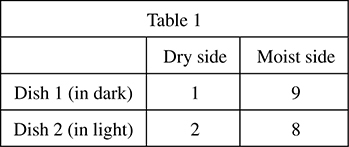
Ten samples of bacteria were placed in each of 2 Petri dishes, the bottoms of which were each half moist and half dry. The dishes were covered with Petri dish lids. Dish 1 was placed in a darkened area and Dish 2 was placed in a lighted area. After 2 hours, the location of bacterial growth in each dish was recorded (Table 1).

Experiment 2

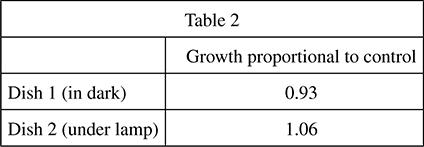
Ten samples of bacteria were placed in each of 2 Petri dishes. The dishes were covered with Petri dish lids. Dish 1 was placed in a darkened area and Dish 2 was placed directly under a 25-watt incandescent lamp, creating a warm, lighted environment. After 2 hours, the amount of bacterial growth in each dish was recorded and compared to the amount of growth in a control sample that was placed in a Petri dish and left in a regularly lighted area (Table 2).

Experiment 3

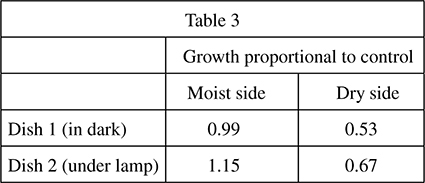
Ten samples of bacteria were placed in each of 2 Petri dishes. Four different environments were created in each dish-dry/lighted, dry/dark, moist/lighted, and moist/dark. The bottoms of the Petri dishes were each half moist and half dry. The dishes were covered with Petri dish lids. Dish 1 was placed in a darkened area and Dish 2 was placed directly under a 25-watt incandescent lamp, creating a warm, lighted environment. After 2 hours, the amount of bacterial growth in each dish was recorded and compared to the amount of growth in a control sample that was placed in a Petri dish and left in a regularly lighted area (Table 3).

1. One reason refrigeration might be used as a means to control bacteria growth is that bacteria:

2. Based on the results of Experiment 3, the greatest proportional growth was observed:

3. Which of the following conclusions is supported by the results of Experiment 1?

4. One criticism of these experiments might be that the presence of more than one sample of bacteria in each Petri dish might have had an effect on the results. Which of the following changes in experimental design could be made to counter this criticism?

5. Bacteria are known to exist on nearly every surface of the world. On the basis of the experimental results, which of the following environments would provide the conditions best suited for a high growth rate?

6. In the 3 experiments, the environmental factors that could influence growth were evaluated by recording data about growth after 2 hours. Because bacteria double population size in short intervals, better information about growth might be achieved by recording data: