Workspace Science Test 124
← Back to Science
Science · Drill 124

Science practice 124

6 questions ~9 min recommended
00:00
Score

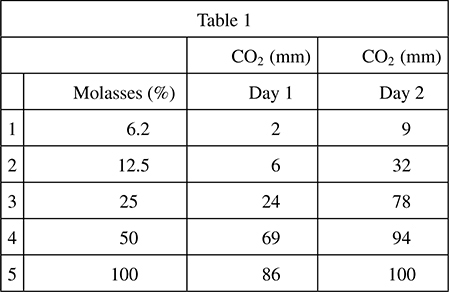
Table 1

Molasses (%) 6.2 12.5 25 50 100
CO₂ (mm) Day 1 2 6 24 69 86
CO₂ (mm) Day 2 9 32 78 94 100

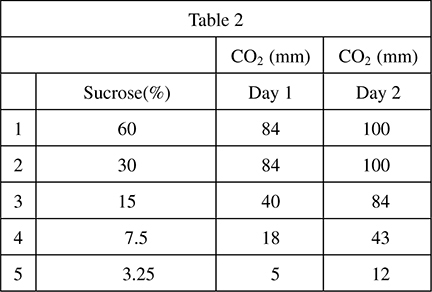
Table 2

Sucrose (%) 60 30 15 7.5 3.25
CO₂ (mm) Day 1 84 84 40 18 5
CO₂ (mm) Day 2 100 100 84 43 12

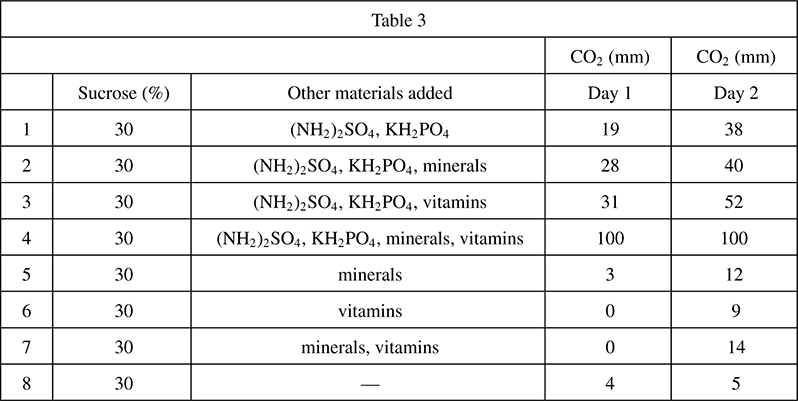
Table 3

Sucrose (%) 30 30 30 30 30 30 30 30
Other materials added (NH₂)₂SO₄, KH₂PO₄ (NH₂)₂SO₄, KH₂PO₄, minerals (NH₂)₂SO₄, KH₂PO₄, vitamins (NH₂)₂SO₄, KH₂PO₄, minerals, vitamins minerals vitamins minerals, vitamins
CO₂ (mm) Day 1 19 28 31 100 3 0 0 4
CO₂ (mm) Day 2 38 40 52 100 12 9 14 5

Yeast is a unicellular fungus, and is arguably one of the most important members of the fungus family, primarily because of its involvement in the process of fermentation. During this process, yeast breaks down sucrose into alcohol and carbon dioxide. The chemical equation for fermentation is given below. Scientists study how to induce fermentation in yeast most effectively.

C12H22O11 + H2O → 4C2H5OH + 4CO2

Experiment 1

Since yeast needs sucrose to ferment and molasses is 60% sucrose, scientists first study yeast grown in molasses. Five test tubes are filled with .4 grams of yeast and various molasses concentrations. Carbon dioxide levels are measured as an indication of fermentation in each test tube after one day and again after two days. These levels are shown in Table 1.

Experiment 2

Five different test tubes are filled with .4 grams of yeast and various pure sucrose dilutions. Carbon dioxide levels are then measured as an indication of fermentation after one and two days. These levels are shown in Table 2.

Experiment 3

Eight more test tubes were filled with .4 grams of yeast and a 30% sucrose solution. Various combinations of ammonium sulfate, potassium dihydrogen phosphate, minerals, and vitamins were added to the test tubes. Carbon dioxide levels were measured after one and two days. These levels are shown in Table 3.

1. Based on Experiment 1, which test tube showed the highest level of fermentation after one day?

2. Which of the following variables was controlled in Experiment 1?

3. Which of the following is a weakness in the design of Experiment 3?

4. Which of the following is the most likely reason that a 30% sucrose solution was used in Experiment 3? Results showed that:

5. Based on Experiments 1 and 2, one can infer that, as compared to molasses, pure sucrose:

6. In order for scientists to decide which conditions produce the most efficient growth of yeast, which of the following experiments would most likely need to be completed next?