Workspace Science Test 125
← Back to Science
Science · Drill 125

Science practice 125

5 questions ~9 min recommended
00:00
Score

= minimum time in stage
= maximum time in stage
45 -
40
35
30 -
25 -
20 -
15
10 -
Egg
Larva
Pupa
Adult

Colony
1
2
3
4
Diet
Apple
Carrot
Oat
Wheat
Avg. larval
size (mm)
25.8
24.5
24.9
25.3
Table 1
Avg. duration
in larval stage
(days)
36.9
39.4
49.1
57.2
Avg. duration
in pupal stagr
(days
7.5
8.4
9.2
10.8
Avg. adult
size (mm)
19.3
19.5
20.6
21.3
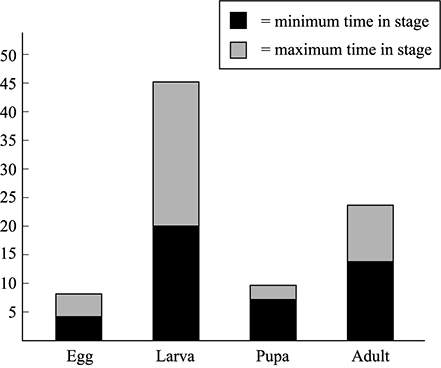
Tenebrio molitor is an arthropod insect which, like 90% of all insects, undergoes the process of complete metamorphosis, meaning that it passes through four life stages: egg, larva, pupa, and adult. In the larval stage, the insect is commonly known as a mealworm; as a full adult it is a darkling beetle. Figure 1 shows the four stages of the T. molitor life cycle (x-axis), as well as data for minimum and maximum days spent in each stage of metamorphosis (y-axis) for T. molitor that were raised by students in a lab.

Figure 1

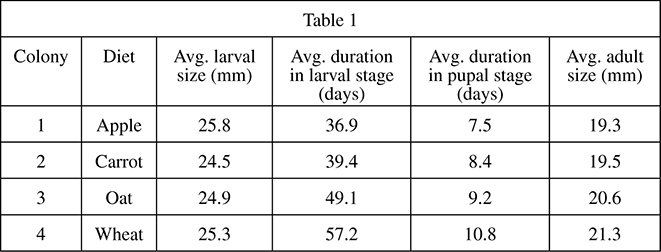
Table 1 includes data recorded for four different colonies of T. molitor raised by students in a lab, including the type of food each colony was given, beginning larval length, duration of time in larval and pupal stages, and final adult length. It was decided that the colonies would be given only one type of food source: either a fruit, a vegetable, or one of two whole grains. Apple was chosen as the fruit, carrot for the vegetable, and oats and wheat for the two whole grains.

1. According to the passage, the Tenebrio molitor beetle must spend at least 20 days in what stage of metamorphosis?

2. According to Table 1, which of the following has the LEAST effect on the final adult size of the Tenebrio molitor beetle?

3. A Tenebrio molitor specimen has been in the same metamorphic stage for 12 days. According to Figure 1, in which stage is it possible for the specimen to be?

I. Egg stage

II. Larval stage

III. Pupal stage

IV. Adult stage

4. Which one of the following hypotheses about Tenebrio molitor growth is supported by the data presented in Table 1?

5. A fifth colony of Tenebrio molitor was raised on barley, another whole grain, in the same lab. Assuming this colony behaved similarly to the other colonies raised on whole grains, what was most likely the average size, in millimeters, of the adults in the fifth colony?