Workspace Science Test 126
← Back to Science
Science · Drill 126

Science practice 126

6 questions ~9 min recommended
00:00
Score

Time (hr)

0

(starting mass)

4

12

Porosity (%)

Table 1

Sample (volume of sample cm?)

Limestone

Sandstone

(33 cm")

(27 cm?)

27 g

24 g

Shale

(30 cm")

25 g

29 g

30 g

31 g

32 g

15

26 g

28 g

29 g

30 g

19

28 g

30 g

31 g

32 g

23

Pumice

(25 cm?)

34 g

35 g

36 g

37 g

38 g

12

Porosity

Porosity

Porosity

Particle size

Uniformity of particles

Density

Oil and natural gas stores are formed naturally in reservoirs. However, these reservoirs are not like the giant man-made lakes that might come to mind; they are underground. In fact, a reservoir occurs in a rock that looks on the surface like any other. The oil and gas pool in millions of tiny pores in the rock. Porous rocks include sandstone, limestone, shale, and pumice. There are several factors affecting porosity (the ability to store fluid in the open spaces located between rock particles). Among these factors are the nature and characteristics of the sand and other sediment that accumulate to form rocks. The sand particle size is not critical to porosity, but the uniformity or sorting of the sand grains greatly affects porosity. Uniform or well-sorted sand will tend to be more porous than poorly sorted sand.

Experiment 1

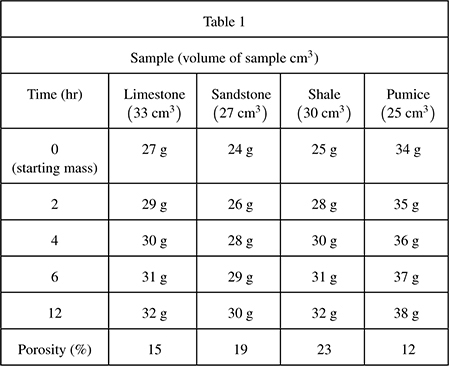
In a laboratory, a scientist wanted to determine the porosity of four samples of different rocks. The scientist recorded the mass of the rock samples prior to the experiment. To measure porosity, the samples were soaked in water and the mass of the samples was recorded periodically. A highly porous rock would have a significant increase in mass the longer it soaked in water, eventually reaching the point at which it could no longer absorb any more water (saturation point). The data was recorded in Table 1.

Experiment 2

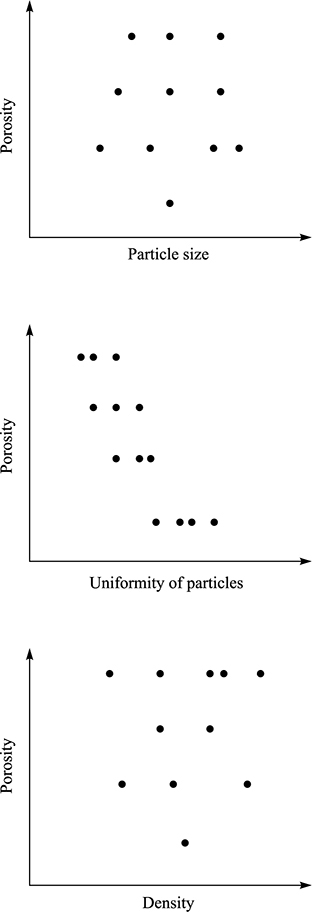
Geologists in Arizona were interested in the porosities of different varieties of sandstone. They documented the relationship between porosity, density, sand particle size, and the uniformity or sorting of the sand grains. The geologists found that, in general, neither density nor particle size affected the porosity if the particles were uniform. However, they did find that in samples with a wide variety of particle sizes, the porosity was generally lower. Also, the presence of contaminants such as clay or silt negatively affected the porosity. The geologists recorded their results in the following diagrams.

1. Which of the following properties would likely result in a porous rock on the basis of the results of Experiment 2?

2. If a sample of rock is studied and found to possess medium-sized particles with a high level of uniformity, the porosity of the rock:

3. Based on the passage, the relationship between porosity and particle uniformity is best described as:

4. A company wants to investigate the idea of creating a large oil reserve to stockpile oil in case of a shortage. Based on the results of Experiment 1, which of the following rock types would be the best choice as a storage medium?

5. Which of the following graphs best represents the relationship between time elapsed and saturation of the rocks observed in Experiment 1?

6. Which of the following findings would NOT be consistent with the information provided about rock porosity?