Workspace Science Test 133
← Back to Science
Science · Drill 133

Science practice 133

5 questions ~9 min recommended
00:00
Score

Bond

Period 1
H-H

Period 2
H-B
H-C
H-N
H-O
H-F

Period 3
H-P
H-S
H-CI

Period 4
H-Se
H-Br

Group 17
H-F
H-CI
H-Br
H-I

Energy (kJ/mol)
436
391
413
393
460
568
326
366
432
279
366

Length (pm)
74
119
109
101
96
92
144
134
127
146
141

568
432
366
298
92
127
141
161

600,
550-
500
450
energy (
400
350
300
250'
60

Relation of bond length to bond energy
• Period 1
• Period 2
A Period 3
× Period 4
* Group 17
100
120
Length (pm)
140
160
180
A chemical bond is the physical phenomenon of chemical substances being held together by attraction of atoms to each other through both sharing and exchanging of electrons or electrostatic forces. Bond energy is a measure of bond strength in a chemical bond. For example, the carbon-hydrogen (C-H) bond energy is the energy change involved with breaking up the bond between the carbon and hydrogen atoms. Bonds with a higher energy release more energy when they form, and are considered to be more stable (less reactive).

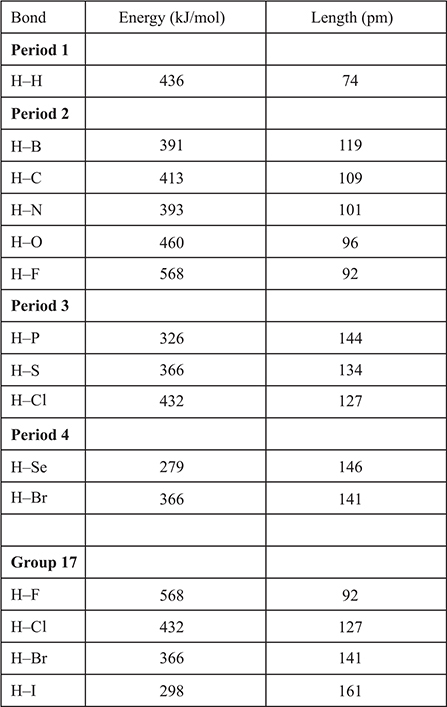
When reacting with nonmetals, hydrogen forms covalent bonds, meaning that the bonded atoms share electrons with each other. Figure 1 shows the bond energies and distances for bonds involving hydrogen and nonmetals (H-X). The chart is arranged by period (rows of periodic table); in addition, the values for group 17 (column 17 on the periodic table) are compared.

Figure 1

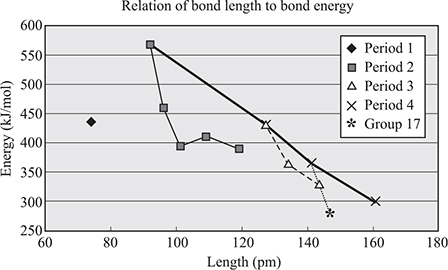
Bond length is the distance between two bonded atoms in a molecule. Bond lengths are measured in molecules by means of X-ray diffraction. A set of two atoms sharing a bond is unique going from one molecule to the next. For example, the oxygen to hydrogen bond in water is different from the oxygen to hydrogen bond in alcohol. It is, however, possible to make generalizations when the general structure is the same. Figure 2 relates bond energy to bond length for H-X bonds between hydrogen and nonmetals. The elements in each period or group are connected by a line (with the exception of the first, which contains only hydrogen).

Figure 2

1. Suppose a certain experiment calls for a very stable substance with bond energy greater than 420 kJ/mol. Which of the following pairs of elements in a compound would yield a stable enough substance?

2. According to the passage, the three most stable bonds shown in Figure 1 are:

3. Which of the following substances would have the highest sum of bond energies (for example, H2O has two H-O bonds) ?

4. Based on observations from Figures 1 and 2, which of the following statements is the best assessment of the data?

5. Which of the following is the correct order for increasing bond lengths for bonds between these pairs of elements: H-O, H-S, H-Se?