Workspace Science Test 132
← Back to Science
Science · Drill 132

Science practice 132

5 questions ~9 min recommended
00:00
Score

Dominant Traits

- Black color (BB)

- Short hair (HH)

Recessive Traits

- White color (bb)

- Long hair (hh)

Level 1: Long hair (hh) x Short hair (HH)

Black (BB)

White (bb)

Level 2: Short hair (Hh)

Short hair (Hh)

Black (Bb)

Black (Bb)

Level 3:

Hh Bb x Hh Bb

HB

hB

hb

HB

hB

HHBB

HHBb

HhBB

hb

HhBb

HHBb

HHbb

HhBb

Hhbb

HhBB

HhBb

hhBB

HhBb

Hhbb

hhBb

hhBb

hhbb

Length | Color

= short black

= short white

= long black

= long white12345
Gregor Mendel is known for his work in genetics. He is credited with discovering how traits (characteristics) are passed from one generation to the next. After his observations of inherited traits, Mendel concluded that each organism carries two sets of information about a certain trait. If the two sets differ about the same trait, one set dominates the other. That way, information can be passed on through the generations, even if the trait is not expressed.

It has since been determined that the presence of certain traits is attributed to genes, and the different forms that genes can take, known as alleles. Dominant alleles (D) produce dominant characteristics; recessive alleles (d) produce recessive charactersitics. Dominant alleles are expressed whenever present (DD, Dd) but recessive alleles are expressed only when the dominant allele is absent (dd).

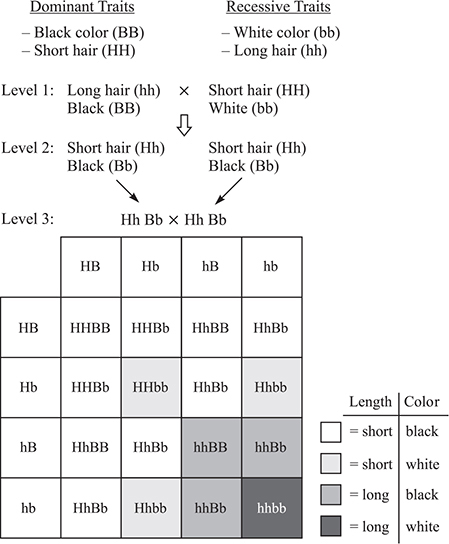
A study was done in which the independence of two traits was tested. In this study, a rabbit with long black hair was mated with a rabbit with short white hair. The dominant trait for hair length is short (H). The dominant trait for hair color is black (B). If the two initial rabbits (level 1 in the figure below) are homozygous for their traits, meaning that the two alleles for each trait are the same, breeding them will result in offspring that have both a dominant and recessive allele for each trait. Such a pairing of alleles is known as heterozygous. If, as in level 2 of the figure, two heterozygous rabbits are bred, the chart (level 3) contains all the possibilities for their offspring.

1. In the figure shown, each numbered level represents:

2. Which of the following statements best explains the observation that offspring of the two rabbits in level 1 must have short black hair?

3. What is the probability that offspring of the level 2 rabbits will have white hair?

4. If several pairs of heterozygous rabbits were mated (as in level 2), what would be the expected ratio for the traits of the offspring (express as a ratio of short black hair: long black hair: short white hair: long white hair)?

5. Which of the following statements might be a reasonable generalization made after examining this study?