Workspace Science Test 131
← Back to Science
Science · Drill 131

Science practice 131

6 questions ~9 min recommended
00:00
Score

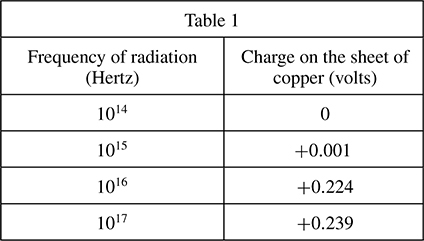
Table 1

Frequency of radiation
(Hertz)

1014
1015
1016
1017

Charge on the sheet of
copper (volts)

0
+0.001
+0.224
+0.239

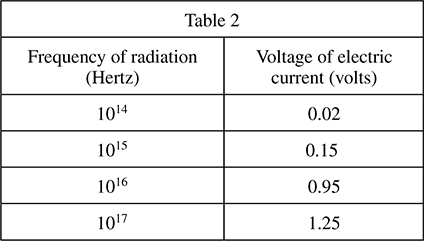
Table 2

Frequency of radiation
(Hertz)

1014
1015
1016
1017

Voltage of electric
current (volts)

0.02
0.15
0.95
1.25
The photoelectric effect is the emission of electrons from matter upon the absorption of electromagnetic radiation, such as ultraviolet radiation or X-rays. Electromagnetic radiation is made up of photons, which can be considered finite packets of energy at various levels. Photons have properties attributed to both particles and waves. This phenomenon is known as the wave-particle duality.

The photoelectric effect is especially noticeable when dealing with metals. When a metallic surface is exposed to electromagnetic radiation that is above the minimum energy threshold (which is specific to the type of surface and material), photons are absorbed and electrons are emitted. No electrons are emitted for radiation with energy frequencies below that of the threshold, as the electrons are unable to gain sufficient energy to overcome the attractive forces within the metal. A scientist wishing to measure the photoelectric effect so as to further understand the nature of photons conducted the following experiments.

Experiment 1

Wishing to measure the energy required to produce the photoelectric effect on a surface of a sheet of copper, the scientist directed a beam of radiation at different frequencies (energies)-measured in Hertz (Hz)-onto the surface. After 5 minutes, the charge-measured in volts (V)-of the sheet of metal was recorded. This was done because if electrons were emitted from the surface, the metal would take on a positive charge. The results were recorded in Table 1.

Experiment 2

Solar cells used to generate electricity are based on the concept of the photoelectric effect; however, the goal of the cell is to capture the emitted electron and create an electric current. The scientist measured the effects of different frequencies (in Hz) of radiation on the current (in V) generated by a certain solar cell. The results were recorded in Table 2.

1. A scientist predicts that in years to come the earth's atmosphere will become much less effective at shielding the surface from radiation of higher frequencies. If this prediction is correct, which of the following is most likely to happen based on results of the experiments?

2. Suppose that the rate of the photoelectric effect is directly proportional to the surface area of the metal exposed. Using a larger sheet of copper metal in Experiment 1 would most likely have affected the results in what way?

3. Which of the following procedures would result in the most accurate values for the effect of frequency of radiation on the photoelectric effect (Experiment 1)?

4. Suppose a scientist wanted to measure the effect of the atmosphere on the photoelectric effect. The scientist could learn most by doing which of the following?

5. Which of the following assumptions did the scientist probably make in choosing these experiments to test the nature of photons?

6. Do the results of the experiments help to explain the nature of photons as finite packets of energy at various levels?