Workspace Science Test 130
← Back to Science
Science · Drill 130

Science practice 130

5 questions ~9 min recommended
00:00
Score

Respiratory rate (no. of breaths/minute)12

40

Mammal 13

Mammal 2

Mammal 3

20

10

Mammal 4

1.0

0.95

0.90

0.85

0.804

Atmospheric conditions (atmospheres)

0.755
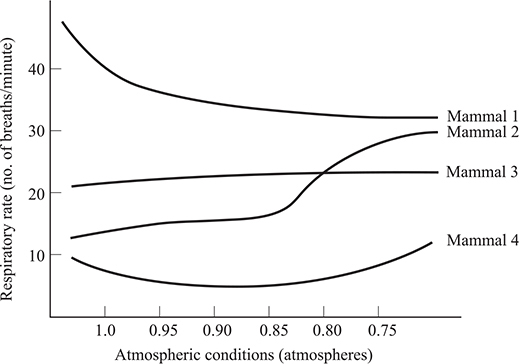
A scientist wanted to observe the effects of altitude on the respiratory system of mammals. Four different species of mammals were placed in a chamber that underwent gradual changes in pressure (measured in atmospheres, or atm) to simulate the atmosphere at high altitudes. After 5 minutes at each atmospheric pressure tested, the average number of breaths per minute (respiratory rate) was determined for each of the 4 mammals while they remained at rest. The data from the experiment are shown in the following graph. (Note: Larger animals typically have slower respiratory rates. Higher respiratory rates indicate rapid breathing, a sign of distress in some mammals.)

Figure 1

1. What is the general relationship between respiratory rate and atmospheric pressure for Mammal 2?

2. At approximately which pressure, in atmospheres, did Mammals 2 and 3 have the same respiratory rate?

3. Further measurements showed that Mammal 4 used significantly more oxygen per minute than Mammal 2. This would be consistent with the data from the graph if:

4. A higher respiratory rate causes mammals to have a higher metabolic rate. Which of the mammals would have a higher metabolic rate at a pressure of 1.0 atm than at .80 atm?

5. Based on the data in the graph, which of the mammals might be native to higher-altitude environments (meaning that they are more comfortable at higher altitudes than at lower altitudes)?